
Contents
Overview
Reinforcement learning (RL) techniques are a cornerstone of modern artificial intelligence, particularly within generative AI development. Unlike supervised or unsupervised learning, RL focuses on training an agent to make sequential decisions in an environment to maximize a cumulative reward signal. This paradigm is crucial for tasks requiring an AI to learn optimal strategies, such as controlling robotic systems, playing complex games, or fine-tuning generative models like large language models (LLMs) and diffusion models. The core challenge lies in balancing exploration (trying new actions) with exploitation (using known best actions) to efficiently discover effective policies. Key algorithms like Q-learning and policy gradients, alongside deep learning architectures, have propelled RL from theoretical concepts to practical applications in building more intelligent and adaptive systems.
🎵 Origins & History
The theoretical underpinnings of reinforcement learning can be traced back to foundational work in areas like optimal control and dynamic programming by mathematicians such as Richard Bellman. Richard Sutton and Andrew Barto published seminal works, including their influential textbook "Reinforcement Learning: An Introduction," which helped consolidate the field. Deep Reinforcement Learning (DRL) is a fusion of RL and deep learning, enabling RL agents to tackle complex, high-dimensional problems previously considered intractable.
⚙️ How It Works
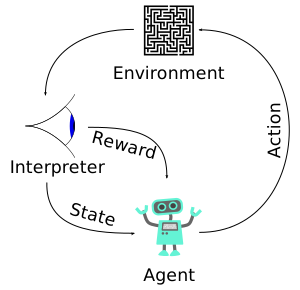
At its heart, reinforcement learning involves an agent interacting with an environment. The agent observes the environment's state, takes an action, and receives a reward (or penalty) and a new state. This process is often modeled as a Markov Decision Process (MDP). The agent's goal is to learn a policy—a mapping from states to actions—that maximizes the expected cumulative reward over time. Techniques like Q-learning learn an action-value function (Q-function) that estimates the expected future reward for taking a specific action in a given state. Alternatively, policy gradient methods directly optimize the policy parameters to increase the probability of actions that lead to higher rewards. The exploration-exploitation dilemma is central, requiring agents to balance trying novel actions to discover better strategies against leveraging current knowledge for immediate gains.
📊 Key Facts & Numbers
The impact of reinforcement learning is quantifiable. The victories of DeepMind's AlphaGo and AlphaStar in Go and StarCraft II, respectively, captured global attention, sparking discussions about AI's potential and future role. Reinforcement learning has influenced public discourse on AI ethics, the nature of intelligence, and the potential for superintelligence, influencing science fiction narratives and public policy debates.
👥 Key People & Organizations
Several key figures and organizations have shaped the landscape of reinforcement learning. Richard Sutton and Andrew Barto are widely recognized for their foundational contributions. Demis Hassabis, CEO of DeepMind, has been instrumental in driving cutting-edge RL research, particularly in game-playing AI and scientific discovery. OpenAI has also made significant contributions, developing advanced RL agents for tasks like robotic manipulation and language generation. Major tech companies like Google, Meta, and Microsoft heavily invest in RL research and development, integrating its techniques into their AI products and services.
🌍 Cultural Impact & Influence
Reinforcement learning has moved beyond academic curiosity to become a cultural touchstone, particularly in its ability to create AI that can master complex human endeavors. The victories of DeepMind's AlphaGo and AlphaStar in Go and StarCraft II, respectively, captured global attention, sparking discussions about AI's potential and future role. RL's ability to learn strategies that even human experts couldn't devise has led to a sense of awe and, for some, apprehension. This has fueled a broader public discourse on AI ethics, the nature of intelligence, and the potential for superintelligence, influencing science fiction narratives and public policy debates.
⚡ Current State & Latest Developments
The current state of reinforcement learning is characterized by rapid innovation and increasing integration into real-world generative AI systems. Techniques like Proximal Policy Optimization (PPO) and Actor-Critic methods are widely adopted for their stability and performance. RL is also being increasingly applied to fine-tune Large Language Models (LLMs) through methods like Reinforcement Learning from Human Feedback (RLHF), aligning their outputs with human preferences and safety guidelines, as seen in models like ChatGPT.
🤔 Controversies & Debates
Significant controversies surround reinforcement learning, particularly concerning its application in high-stakes domains. The exploration-exploitation dilemma itself raises ethical questions: when is it acceptable for an AI to 'explore' potentially harmful actions, even in simulation? The use of RLHF in LLMs, while aiming for alignment, has been criticized for potentially encoding biases from human labelers or creating 'alignment tax' that stifles model creativity. Furthermore, the opacity of complex DRL models—the 'black box' problem—makes it difficult to understand why an agent makes certain decisions, leading to concerns about accountability and safety, especially in autonomous systems like self-driving cars or AI-controlled weaponry. The potential for RL agents to discover unintended and potentially dangerous strategies remains a persistent concern.
🔮 Future Outlook & Predictions
The future of reinforcement learning techniques in generative AI is poised for significant expansion. Researchers are actively exploring methods for multi-agent RL, where multiple agents learn collaboratively or competitively, opening doors for complex simulations and decentralized AI systems. Meta-learning and few-shot RL aim to enable agents to learn new tasks with minimal data, accelerating adaptation. The integration of RL with other AI paradigms, such as causal inference and symbolic reasoning, is expected to lead to more robust and interpretable AI. Predictions suggest RL will play a critical role in developing truly autonomous AI systems capable of complex problem-solving in dynamic, real-world environments, potentially revolutionizing fields from drug discovery to climate modeling.
💡 Practical Applications
Reinforcement learning techniques are finding diverse practical applications across numerous industries. In robotics, RL is used to train robots for complex manipulation tasks, such as grasping objects or assembling components, often leveraging simulations from platforms like Unity or Unreal Engine. In finance, RL algorithms are employed for algorithmic trading and portfolio optimization, aiming to maximize returns while managing risk. The gaming industry uses RL to create more sophisticated non-player characters (NPCs) and to test game balance. Beyond these, RL is crucial for optimizing resource allocation in data centers, personalizing recommendations on platforms like Netflix, and controlling complex industrial processes. Its role in fine-tuning LLMs for conversational AI, as demonstrated by ChatGPT, is perhaps its most visible application today.
Key Facts
- Category
- technology
- Type
- topic